
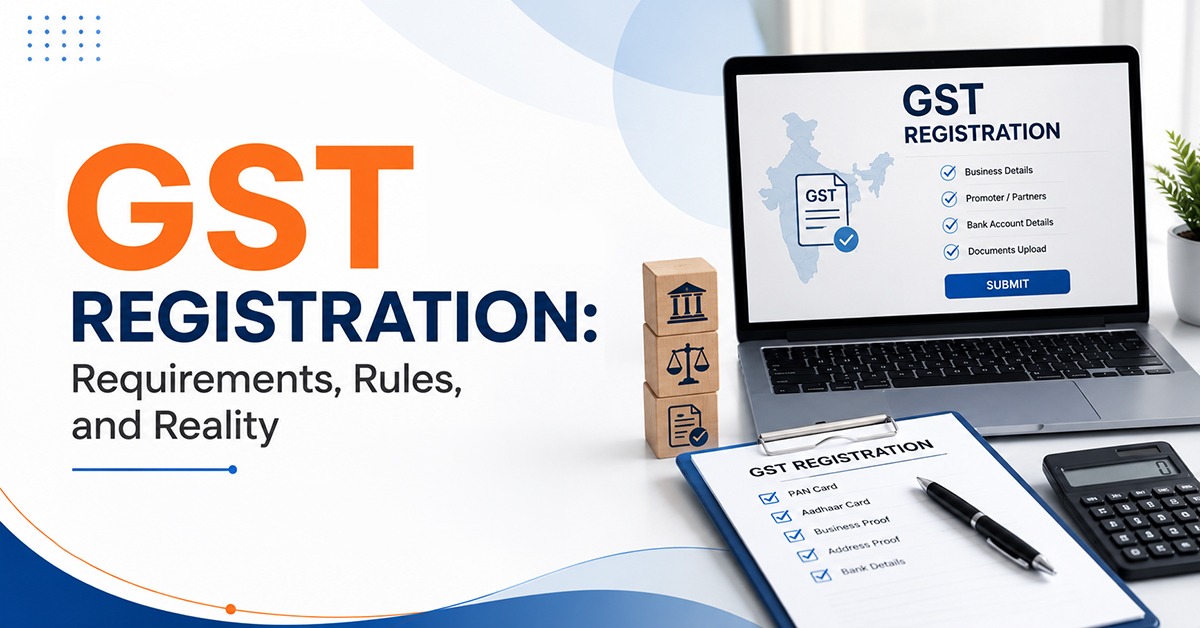
As a business expands, GST registration stops being optional and becomes a legal requirement. Delay it, and you risk heavy penalties plus the loss of valuable Input Tax Credit (ITC).
Knowing exactly when registration becomes mandatory is therefore essential for every business owner. Here's what you need to know for FY 2026–2027.
What is GST registration?
GST registration is the process of applying to the tax authorities for a 15-digit Goods and Services Tax Identification Number (GSTIN). Once approved, your business receives a GST certificate — Form GST REG-06 — which entitles you to collect GST from customers and claim input tax credit.
GST registration limit: Turnover thresholds
Your registration limit depends on what you supply and where you operate:
Category of state Supply of goods Supply of services Normal category states ₹40 lakh ₹20 lakh Special category states ₹20 lakh ₹10 lakh.
The ₹40 lakh threshold applies only if your state has notified it, you supply goods, you don't operate in restricted sectors (ice cream, pan masala, tobacco), and you aren't making a mixed supply. A mixed supply of goods and services is measured against the lower services turnover limit instead.
Once you cross the applicable limit, you must apply for registration within 30 days.
Compulsory registration, irrespective of turnover
In some cases, even a business with ₹1 of turnover must register:
Makes inter-state taxable supplies of goods
Supplies goods or services through e-commerce platforms (Amazon, Flipkart, Meesho, etc.)
Operates an e-commerce platform
Is a casual taxable person
Is a non-resident taxable person
Is liable to pay tax under the Reverse Charge Mechanism (RCM)
Acts as an agent supplying on behalf of another taxable person
Is required to deduct TDS or collect TCS under GST
Is an Input Service Distributor (ISD)
Why timing matters
Registering late doesn't just invite a penalty — it breaks your ITC chain. Tax paid on purchases before your effective date of registration is generally lost, and B2B customers may avoid an unregistered supplier because they can't claim credit on your invoices.
Where a Chartered Accountant makes the difference
On paper, GST registration looks like a form-filling exercise. In practice, the judgement calls are where businesses go wrong. A Chartered Accountant helps you:
Determine whether you actually need to register. Aggregate turnover includes exempt supplies, exports and inter-state stock transfers under the same PAN — a calculation many businesses get wrong.
Pick the right registration type. Regular scheme, composition scheme, casual taxable person — each has different compliance loads and cash-flow implications.
Get the application right the first time. Correct HSN/SAC codes, principal place of business proof, authorized signatory details and Aadhaar authentication are the most common reasons applications get queried or rejected.
Respond to departmental notices. If the officer raises a query in Form GST REG-03, you have limited time to reply. A CA drafts and files it properly.
Set up compliance from day one. Invoice formats, e-invoicing applicability, return filing calendar and ITC reconciliation — so your first GSTR-3B isn't a scramble.
GST rules also change frequently through notifications and circulars. A CA tracks those changes so you don't have to.
Get it done right
At CA Pramod Singhal, we handle the entire process — from checking your eligibility and preparing documents to filing your application and managing follow-up compliance.
Need expert assistance? Get in touch with our team today for personalized guidance and end-to-end support. Whether you're applying for the first time or need help navigating complex requirements, we're here to help you achieve a smooth and successful outcome.
Contact CA Pramod Singhal today and take the next step with confidence.